
Glen Cove Previous Residents Across Record Eras
A backward address trail begins with an era check. Nassau's current electronic land-record database began in July 1992. Earlier documents require the historic county repository and its older index material. Glen Cove directories, newspapers, maps, and census resources then add dated household or building context. Each source describes a different kind of connection, so the record date and the stated role belong beside every result.
| Source | Years it covers | Where held | What it can show |
|---|---|---|---|
| Current official land index | Electronic database from July 1992 | Nassau County Clerk | Recorded deeds and related later filings |
| Historic official records | Older indexes and record groups, including 1840-1934 index books | Nassau historic repository | Direct and reverse indexes, deed records, plat books, and page-search leads |
| Bowne directory | 1867 | Digitized local heritage copy | Name, occupation, and address, with stated incompleteness |
| Other verified directory references | 1868 Curtin, 1871 reference, and 1923-24 Polk material | History Room and local research context | Dated address or business leads, with known catalog gaps |
| Sanborn and local maps | 1893, 1902, 1908, 1915, and 1925 sets located | Library of Congress and local collections | Structure, use, street, and lot context, not identity proof |
Start with a narrow time question. A deed may establish a conveyance, a directory may show a historical address listing, and a map may show the building footprint. None alone proves a complete household.
Freeze a Glen Cove Address Record
Before searching for past residents, capture the current parcel facts in the Nassau Land Record Viewer: property situs, displayed Section, Block, and Lot, map setting, assessment context, and source date. The Land Record Viewer is an assessment and GIS research layer. It can show a current owner or a mailing address, but those are not occupancy fields.
Check the SBL formatting against the Clerk before moving to a land record. The research notes that the viewer's placeholders can differ from the Clerk database. This small reconciliation step helps keep a Glen Cove address from being confused with a similarly named street or a nearby mailing ZIP.
Trace Glen Cove Deed Records
The County Clerk's recorded documents are the backbone of a past-residents search when the question is legal ownership. Begin with the latest deed under the Clerk-conforming SBL. Read the grantee, grantor, recording date, and book, page, or instrument information. The prior grantor becomes the next name to investigate. Repeat the chain until the current online index reaches its boundary, then use the historic direct and reverse indexes.
- Search the current official land index using the Clerk-ready SBL and locate the recorded deed.
- Record its grantor, grantee, recording date, and book, page, or instrument detail without assuming either party lived at the address.
- Use the prior grantor and document date to locate the earlier conveyance.
- At the electronic boundary, search the historic direct and reverse indexes with spelling variants.
- Pair each ownership transition with a dated directory, newspaper, map, or census source before describing past residents.
A grantor is the party conveying an interest; a grantee receives it. These roles document a transaction, not a household. Certified copies and current procedures should be confirmed with the Clerk before ordering them.
The Clerk's public land-record role is distinct from the assessment viewer's research function. The County Clerk maintains the official real-property index and recorded documents, including deeds, mortgages, assignments, satisfactions, and liens. The assessment layer can help locate the parcel and SBL, but it should not replace the recorded instrument when the question is a transfer date or chain of title. Keep the current parcel fields and the recorded-document citation side by side.
Older document research may also surface a plat or property-card lead. A plat can explain lot layout or a subdivision reference, while a property card may provide useful historic parcel context. Neither should be used to fill a gap in a chain of title without the matching deed or index reference. Where the document is unclear, write the uncertainty down rather than attaching a person to the property by inference.
Glen Cove Previous Residents in Historic Records
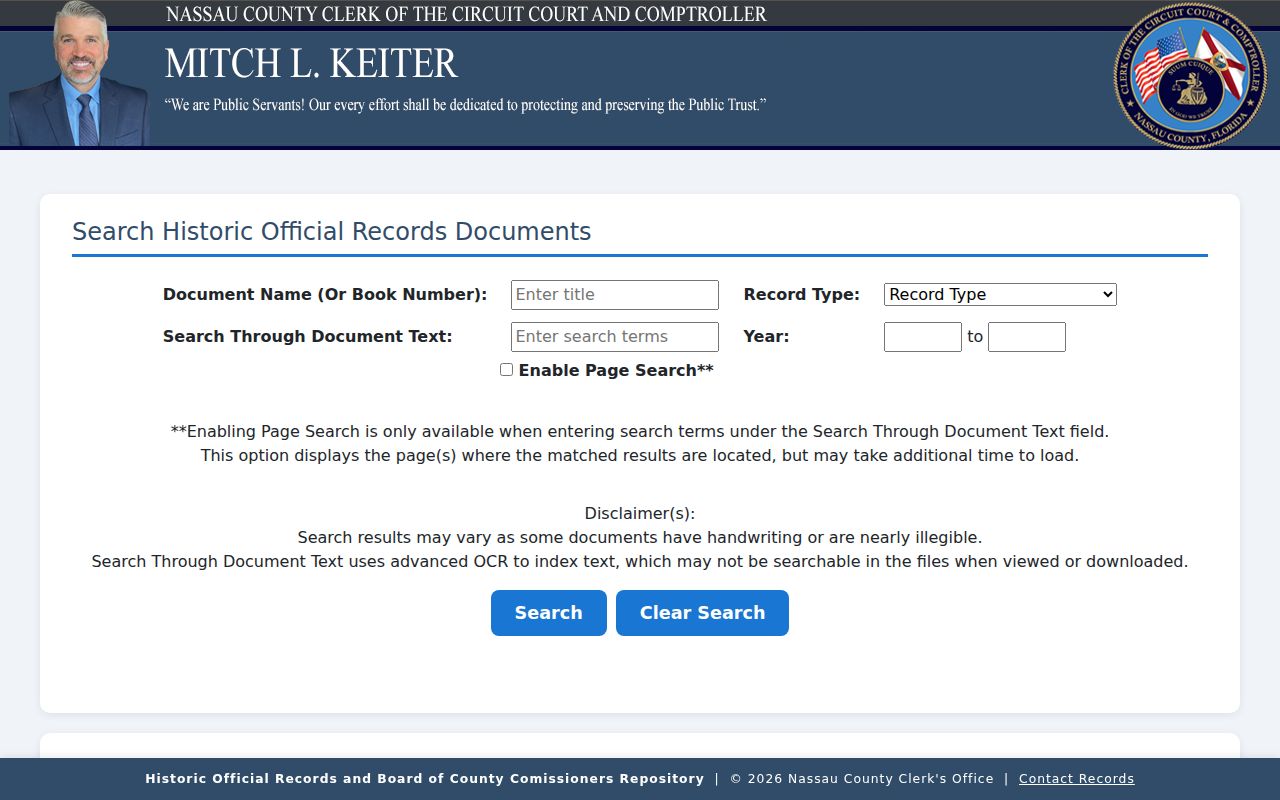
For the pre-electronic part of the trail, the Nassau historic official records repository provides OCR and page-search access to older materials. Its available search controls include Document Name or Book Number, Record Type, Search Through Document Text, year from and to, and Enable Page Search. The listed historic groups include index books, direct and reverse indexes, official records, deed records, marriage-license material, and plat books.
The historic Nassau repository search is shown here as the transition from later deeds to older record books.
OCR and handwriting can miss a name. Search a surname with spelling variants, inspect the scan, and preserve the page or book reference. The repository is a strong route to a historical document, not a substitute for the date and role recorded in it.
Glen Cove Previous Residents in Directories
The Robert R. Coles Long Island History Room is the local bridge between property records and historic address evidence. Verified directory points are the 1867 Bowne directory, the 1868 Curtin reference mentioned in Bowne's introduction, a 1871 directory reference, and 1923-24 Polk material discussed by the History Room. The full Curtin and 1871 volumes were not located as official digital copies, and a complete later run was not verified. Ask the History Room for catalog, shelf, microfilm, or collection guidance rather than filling those gaps with guesses.
Bowne uses name, occupation, and address columns and states that the directory is incomplete, especially for hotels, boarding, and food establishments. The 1923-24 Polk references on the Orchard page locate historical businesses on First, Cedar Swamp, Grove, and Capobianco. These are dated historical findings, not present address listings.
The History Room has more than directories. Its holdings include maps, local newspapers, microfilmed documents, photographs, manuscripts, and genealogy resources. Its property-history guidance recommends building an address chronology from maps, newspapers, census records, and secondary sources, then checking descriptions against primary records. Public hours listed in the research are Monday from 2 to 5, Thursday from 9 to noon, or by appointment. Ask for the relevant finding aid, reel, vertical file, or manuscript box because an online mention may not describe the full collection.
Note: A directory entry belongs to the issue date, and the missing-volume gaps are as meaningful as a successful address match.
Glen Cove Residents in Census Records
Once a deed or directory supplies a period and name, test it with local newspaper and census resources. The History Room offers census and genealogy tools, local newspaper holdings, and an obituary index of about 25,000 Glen Cove newspaper listings from the late 1800s onward. The index is a locator. Review a microform or original newspaper page before citing the notice.
The digitized newspaper archive has full-text searching with people, places, and events options plus Country, State, City, and Title filters. Search old street names, initials, married names, business names, and spelling variants. OCR is only a lead, so open the scanned page, preserve the issue date and page, and distinguish a notice from an advertisement or editorial mention.
A useful sequence is deed date, then directory or census date, then a newspaper check close to that period. It creates a dated trail without assuming a legal owner and a person named in a notice were the same household.
Glen Cove Street Records on Sanborn
Sanborn fire-insurance maps make the built environment legible when a house, lot, or street alignment changed. The Library of Congress holds a December 1908 Glen Cove set of 21 sheets and also lists local sets from 1893, 1902, 1915, and 1925. They can show structures, uses, construction details, and insurance geography. They cannot establish who lived in a building.
Pair a map sheet with a directory or newspaper dated near the same year. This matters where older street names appear in a directory but the modern parcel system uses a different form. The History Room's property-history method similarly starts with the description or SBL and builds a chronology from maps, newspapers, census records, and primary records.
Glen Cove Previous Residents Need Roles
A backward trail can include an owner, occupant, business contact, heir, permit applicant, obituary subject, or court party. Do not collapse those roles into one claim. A deed identifies the parties to a conveyance. An assessment roll separates a property situs from an owner mailing address. A directory shows an address association at publication. An obituary, census, or newspaper item needs its own date and source context.
- Chain of title
- The sequence of recorded property transfers used to trace ownership interests.
- Grantor
- The party shown as conveying an interest in a recorded instrument.
- Grantee
- The party shown as receiving that interest.
- Legal description
- The property identification used in a legal record, often connected to an SBL or plat reference.
Lawful personal use. Use Glen Cove house-history records for family research, estate questions, preservation research, and civic context. Do not use historical material to stalk, harass, intimidate, or expose a protected person.
For the underlying volumes and their access gaps, use the Glen Cove city directory collections rather than treating an undated index result as a complete address history.